[pms-logout text="Bienvenido, {{meta_user_name}}" link_text="Salir"]
Entrevista | Laurent Ney
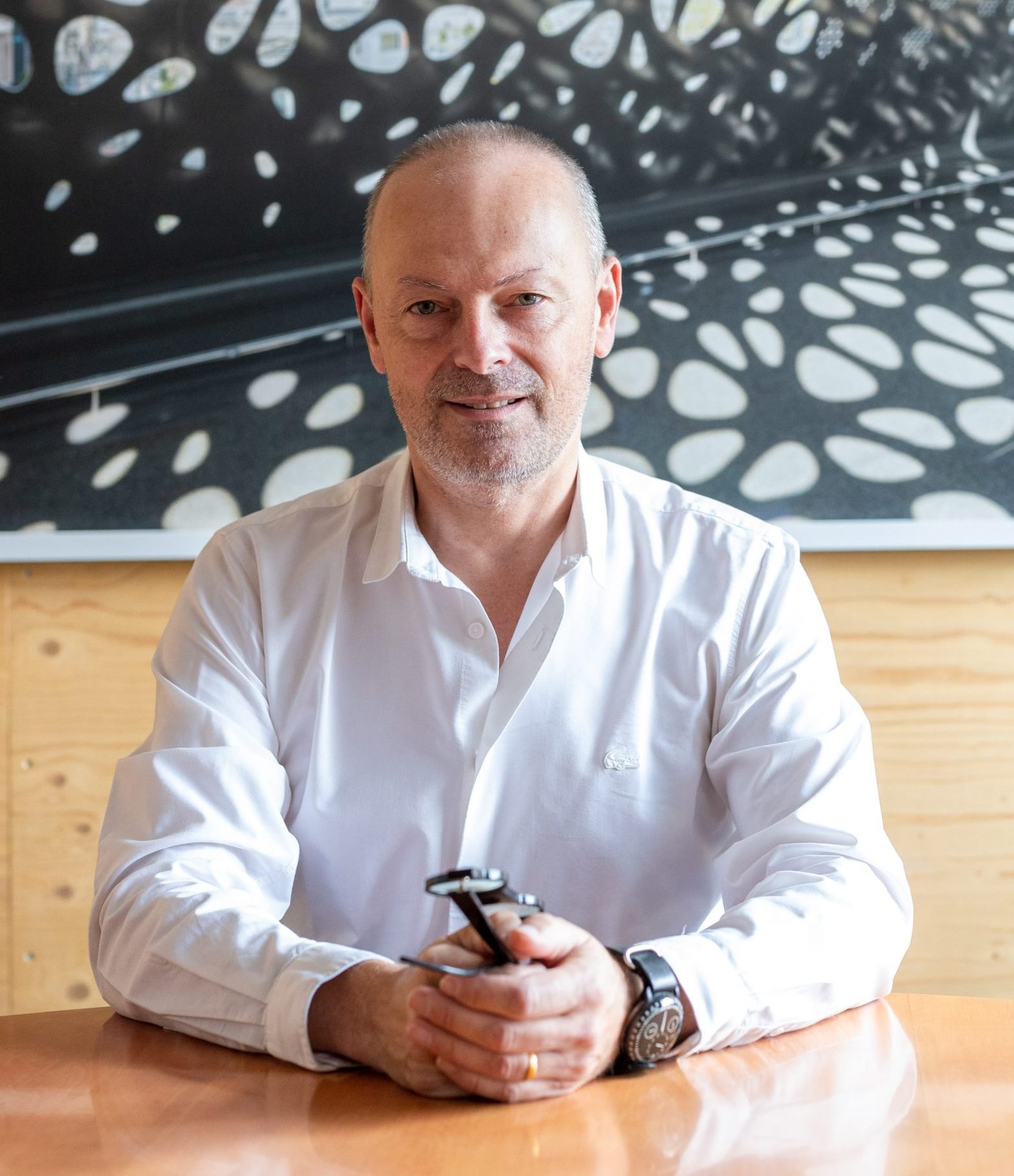
CEO de Ney & Partners | Civil engineer and architect
“We have a social responsibility in achieving the best possible design quality”
The footbridge of Tintagel Castle, situated in an imposing protected natural area in Cornwall in southern England, was designed by Laurent Ney using steel, wood, and slate. This civil engineer and architect asserts that «infrastructure has a big and long lasting impact on our nature,» and therefore «we cannot permit us to build badly».
José Romo Martín (CEO de FHECOR)
The Tintagel footbridge is in a very special location. What did the site suggest to you?
The Tintagel Footbridge was built in Cornwall (UK). The site is very powerful, wild, rough and of outstanding natural beauty. It is also speaking to the collective imagination because of its history and legends. The place relates to the legend of King Arthur and the Knights of the Round Table. Here, legend replaces history, and imagination supersedes reality. It is also a magnificent and very fragile site. It was important to find a solution which respected this fragility and the ‘locus geni’.
How do you approach a competition like this?
In a competition you must try to understand the ambition and the vision of the client. In this case the requirements were well formulated, but of course when you align all these requirements, they are sometimes contradictory. As a designer you must make a design that maximize the fulfilment of the requirements and make a hierarchy between them.
But it is also important to transcend the practical questions and get to a higher level. The proposed solution should add a coherent layer to the already complex story of the site.
Is the solution in two cantilevers that barely touch each other very special? How did this idea come about? Have you thought about it before?
No, we had not thought of this before, the solution came during the design process. We started with different typologies and ended with a shortlist of possible designs. The arch bridge was one of them. Due to the difficult accessibility of the construction site, the bridge had to be built in cantilever, a half bridge from each side.
By closing the bridge in the middle, we introduced hyperstaticity in the system with high efforts in the upper and lower chord, this had no structural advantage and could be seen as a risk in this “lively” geotechnical site. We finally decided to let this joint open. It tells somethings of the construction of the bridge and fits well in the storytelling of the site.
Did the historical context have any influence on the solution you proposed? In what way?
In some ways yes, because we tried to make a timeless bridge, a bridge that all the people visiting the site would accept. We integrated this on different levels, with the materiality for instance: we used local materials as slate, steel for the bridge and timber for the railing, which are all materials that existed in medieval times. The second level is the typology of the arch bridge which is also used since more than two millennia.
Another level is the fact that we respected a void between the mainland and the peninsula. As the ancient castle was probably always split into two sections connected by a wooden bridge or a drawbridge.
Did the way the footbridge was built influence the design in any way? In what way?
The site is not accessible by cars and trucks. We had to be inventive in the way of building this bridge. The design included from the beginning this aspect and was integrated in the design. After identifying the maximum weight that could be brought and placed on the site (5 tons) we concluded that the cantilever solution was the most efficient. The first elements were brought by helicopter and the bridge elements were placed by a cable crane. The solution we proposed did not need any temporary elements and was as stable during construction as in finished stage.
The truss is a structural type that you have used more than once, what would you highlight about this type of solution in terms of shape and resistance?
In the case of the Tintagel footbridge the form of the truss is directly related to the bending moment in the structure. In the middle of the bridge, where the bending moment is zero, we have only 175 mm of height at the abutment where the moment is the highest, we have a leverage arm of 4,5 m. So, there is a clear identification of the lower member which takes compression and the upper member, the deck, which takes tension. And then, you have the diagonals which take the shear force during the mounting stage.
There is a clear hierarchy between these elements. These hierarchy has been emphasized by using stainless steel and a small rhythm for the diagonals. They visually disappear in the reading of the structure. Also, the way how these diagonals are fixed to each other is peculiar. The diagonals are not interrupted but form a diamond shape which is fixed one to the other.
So, this very classical solution of diagonals gives a potential design richness. If we look at the period where trusses were invented, the Warren, Pratt and a lot of others, we see this formal richness which we can even more develop today. The clarity with which a truss takes up efforts is a real help for bridge designers and leads to structurally sound designs.
Was designing a project in the UK something special for you? Is designing in the UK the same as designing in Belgium? What are the differences?
Designing in different countries means dealing with different cultures. Designers have to adapt themselves to the local context. So yes, United Kingdom is another context, but designing is not fundamentally different from other European countries.


In the UK it is very common for bridge and footbridge competitions to be led by architects. What was your relationship with William Matthews Associates like? Who did what?
Contractually Ney & Partners was in charge of the architecture and the structural design of the Tintagel bridge. In the competition phase, Ney & Partners had the lead for the design of the bridge. William Matthews Associates was our local architect and in charge of the execution of the project on site.
Can you tell us something about the construction? What were the main challenges and how were they solved?
The main challenge was the inaccessibility of the site, there is no road going to the construction site, the nearest road for heavy vehicles is 500 m away. So, we had to find a solution to bring the material to the building site. This had an influence on the general design of the bridge. Moreover, in the UK the maximum load capacity of helicopters is 5 tons, the same weight restrictions apply to cable cranes we used. So, this maximum weight defined the weight of different segments of the bridge we could transport. The sections are measuring 4 to 5 m, including all the constituent parts of the bridge.
Secondly, we had to minimize our interventions on the site, as the zone is protected as an Area of Outstanding Natural Beauty (AONB).
Finally, how do you see bridge design in Europe and what trends do you see?
We have an interesting and long bridge history in Europe, we have interesting bridges and capable bridges designers.
As to the trends, circularity and sustainability in bridge design will be one of the main issues in the future. The answers to these questions are complex and surely different to the construction of buildings.
We are at the tipping point to a new mobility. Infrastructure as a whole and bridges in peculiar must be adapted to these carbon free mobility.
Robustness, less material and greater longevity are the challenges of the near future.
Do you have any final comments or thoughts on Bridge Design or Bridge Industry?
What is important for me is that we as designers have a social responsibility in achieving the best possible design quality. Infrastructure has a big and long lasting impact on our nature, surrounding and quality of life. We cannot permit us to build badly in the finite world we are living in. It is also the only way that big infrastructure projects are accepted by the public.
Building a bridge should be an advantage, not only for the heavy mobility, but also for the local habitat and the nature. This can only be achieved if the vision of the client embraces this ambition. We, as designers, client and bridge industry have the responsibility to build a better world. The industry understands this, and I notice the last years a considerable mind shift also on the side of contractors.


